
What IELTS is and how it can help you immigrate to Canada

IELTS is required to immigrate to Canada. What is this language test, how much does it cost, and how do you register for it?
To immigrate to an English-speaking country or to study at an English-speaking university, you need to prove your language skills. You can do this by taking a language test.
IELTS is the most popular and demanded English test for studying and immigrating to Canada, as well as the UK, Australia, and New Zealand. The test certificate is valid for two years.
There are three versions of the IELTS exam:
- IELTS Academic — for admission to academic institutions;
- IELTS General Training — for immigration applications;
- IELTS Life Skills — for those on a visa or immigrating to the UK.
IELTS assesses 4 language skills:
- Listening;
- Reading;
- Writing;
- Speaking.
IELTS requirements for immigration to Canada

Canada accepts IELTS Academic exams for university and college admission and IELTS General Training for immigration.
The required scores for admission depend on the particular institution, but it is often IELTS 6.0. However, there are also admission options that do not require a language test at all.
As far as immigration is concerned, the language requirements are also different as there are so many programs in Canada for different candidates. Moreover, language assessment in Canada is based on the Canadian Language Benchmark (CLB) system. That is, IELTS scores are converted into CLB scores, which you can read more about here.

This weekend Canada switches to winter time

A new era for Canadian athletes

Canada celebrates its National Day and reflec...

Rising inflation in May threatens rate cuts i...

Canada Prepares for a Sharp Increase in the E...

High Auto Insurance Rates for Immigrants Spar...

Canadian intelligence raises alarm: China's i...

Canada continues to attract skilled professio...

How the food supply chain in Canada works and...

The mysterious disappearance of a taxidermy g...

The remains of a mysterious ship have been fo...

Saskatchewan raises age limit for tobacco pur...
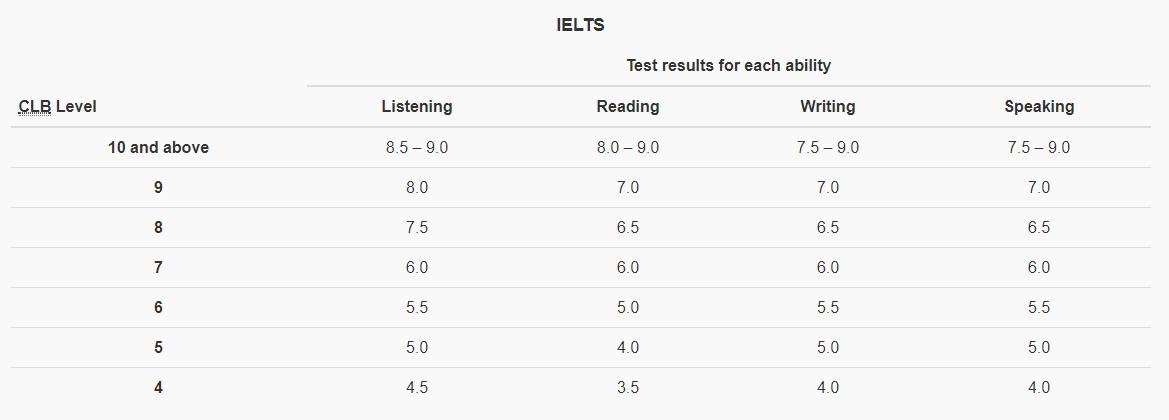
In most programs, the minimum language requirements range from CLB 4 to CLB 7. CLB 4 is IELTS 4.5 for listening, 3.5 for reading, and 4.0 for writing and speaking. And CLB 7 corresponds to an IELTS score of 6.0 for each language skill.
Most immigration programs award points to applicants for various factors, including language. If the applicant's level is higher than what the program requires, more points are awarded and this increases the chances of immigration.
Let's take a look at the requirements of some popular Canadian immigration programs.
Express Entry
Three federal immigration programs operate through the Express Entry system.
The Federal Skilled Worker program requires a CLB level of 7 or above. This is a score of 6.0 for each component of the IELTS exam.
The Canadian Experience Class program requirements depend on the applicant's qualifications. For managerial and high-skilled occupations, CLB 7 is required, while for medium-skilled occupations and workers, CLB 5 is required, or IELTS 4.0 for reading and 5.0 for other skills — listening, writing, and speaking.
The Federal Skilled Trades program requirements are also divided, but by skills. For listening and speaking you need to get CLB 5 (IETLS 5.0 in all skills), and for reading and writing, you need CLB 4 (reading — IELTS 3.5, writing — IELTS 4.0).
Ontario Provincial Program

Ontario's provincial program has many streams for different candidates, and the language requirements vary.
For example, the Human Capital Priorities stream requires a CLB level of 7, i.e. IELTS 6.0 in all skills.
The Foreign Worker stream has no language requirements at all. However, if a candidate passes IELTS with a score of 6.0 or above, they will be awarded additional points, which will increase their chances of immigration. The criteria are the same as for the International Student stream.
British Columbia Provincial Program

This program has other peculiarities. For example, in the skilled workers and international graduates streams, there are language requirements only for candidates in medium-skilled and working trades. They need to show a CLB level of 4. Translated into IELTS scores, this is 4.5 for listening, 3.5 for reading, and 4.0 for writing and speaking.
Also, the stream for entry-level and semi-skilled professionals requires all applicants to know a language at the CLB 4 level.
Atlantic Immigration Program

The IELTS Atlantic Immigration Program requirements depend on what profession the candidate has.
Management and high-skilled occupations, as well as middle-skilled occupations and laborers, must have a CLB level of 5. Alternatively, IETLS 4.0 for reading and 5.0 for other skills.
Occupations that usually require high school graduation or a few weeks of on-the-job training are sufficient for CLB level 4. The following IETLS scores correspond to it: 4.5 for listening comprehension, 3.5 for reading, and 4.0 for writing and speaking.
Immigration programs for entrepreneurs
In most programs for those applying for permanent residence through business, the language requirement is minimal — CLB 4.
Cost of IELTS

The cost of taking the IELTS exam varies from country to country. For convenience, prices are given in American dollars:
- Canada — $167 to USD 181;
- USA — USD 250;
- Australia — USD 260;
- Philippines — USD 217;
- People's Republic of China — USD 297;
- United Arab Emirates — USD 327;
- Spain — USD 241;
- Latvia — USD 250.
It is also possible to take IELTS Online, but it is only suitable for those who need the IELTS Academic exam. IELTS Online costs USD 128.
Registration for the exam

You need to register for IELTS online. Registration is simple and intuitive and takes place on the official website.
You will need to choose the country where you are going to take the test, the version of the exam, the form of the exam (paper or computer-based), and a suitable date. The speaking part usually takes place on one day and the listening, reading, and writing parts on another. But when you register, you can put the speaking part on the same day as the other parts.
At the end of the registration process, you will need to create an account with the British Council and add your passport details, address, and contact information.
You can pay for the test immediately with an international bank card or later by other means, such as bank transfer. After payment, a scan of the receipt will be required, and when payment is confirmed, a scan of the identity document will need to be uploaded.
Stages of IELTS
Before the exam, you will receive an email telling you where the test will take place, as well as instructions on what you can bring with you. The most important things you should not bring are electronic devices and even wristwatches. There are usually lockers at the test sites where you can leave your phone and other items. You can also bring water in a clear bottle and writing materials.
It is advisable to arrive at the test venue in advance to find the right classroom and floor and to register for the test on time. Yes, there will be another registration at the test venue, so you must have your passport with you as well.
Speaking

Speaking consists of three parts. The first part is introducing yourself to the examiner and talking about general topics. The second part is a discourse on a topic. The examiner gives you a topic and you should talk about it for at least 1 minute. The examiner may ask a few clarifying questions as your story progresses. The third part is a continuation of this dialog, but the questions about the topic raised usually become more "global" and complex. The total Speaking time usually does not exceed 15 minutes.
Listening
Listening consists of four parts: usually two dialogues and two monologues. Before the test begins, you will be given an assignment sheet and an answer sheet. You do not have to write your answers on the answer sheet right away, as you will have 10 minutes at the end of the test to transfer your answers from the draft to the test sheet.
Each audio recording is more difficult than the previous one and is played only once. In total, the test includes 40 questions of different types. The examinee's task is to listen to the audio recording and find answers to the questions on the task sheet. The total duration of this part of the exam is 40 minutes.
Reading

The tasks in the reading part differ depending on the version of the test you are taking. In IELTS Academic, the texts are usually on academic topics and are considered more challenging, as well as containing scientific vocabulary. IELTS General Training contains texts on general topics that are easier to understand and smaller in length. The reading contains three texts and 40 questions to be answered in 60 minutes.
Writing
Writing consists of two tasks and lasts 60 minutes. Like Reading, writing differs depending on the version of the test.
In IELTS Academic you will have to describe a graph, diagram, map, or table in the first task (approximately 150 words), and in the second task, you will have to write an essay (approximately 250 words) in which you have to express your view on some problem, consider the situation from several sides, agree or disagree with the thesis in the topic and explain why you hold such an opinion.
In IELTS General Training, the first task should be about 150 words, but instead of describing a graph or table, you will need to write a letter. It can be a letter to a boss or a friend, but it should usually contain a description of a problem and options for solving it. The second assignment is often an essay of the same length as the Academic version, but usually on a less complex topic.
Where to prepare for IELTS?

Passing IELTS with a good score is a difficult but achievable task. You need to know about the nuances of the exam, practice a lot, and have a high level of language.
We always recommend learning English at ILAC, a Canadian language school. It has won numerous Canadian and international awards, accepts students from all over the world, and cooperates with many universities in Canada.
At ILAC, you can improve your overall language level, prepare for the IELTS exam, or complete an English program for admission to Canadian universities without taking a language test. One online English class at ILAC costs less than USD 5.
Click the link and start improving your English at a world-renowned language school.