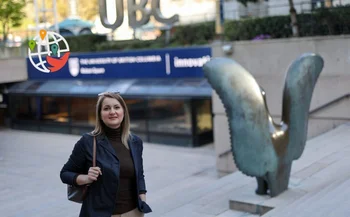
How Valeria enrolled in a college in Toronto and got a visa in six weeks

How to choose the right program, gather the necessary documents, and avoid rejection — using Seneca Polytechnic as an example.
Stories about studying in Canada usually come down to a single line about getting a visa approved. Behind that line lies nearly a year of work that starts long before any application is submitted — beginning with choosing the right program. Below is a breakdown of Valeria's journey: a Russian university graduate with a dual bachelor's degree. Her study permit application was processed in six weeks, and the whole process — from the first list of programs to landing in Toronto — took about nine months.
Choosing a Program and a City
The starting point was her academic profile: a dual bachelor's degree, a strong GPA, IELTS 7.5, and a year of study at a foreign university. Based on that, the search focused on two-year marketing and digital marketing programs designed for applicants who already hold a degree, with a September 2026 start date.
Our team put together five options across different cities and two provinces. The differences go well beyond geography. Some programs emphasize marketing communications and analytics, while others go deeper into applied digital marketing, SEO, and e-commerce. The surrounding conditions vary too: on-campus housing availability, cost of living, and how competitive the local internship market is. For one of the options, the team flagged upfront that it would need to be confirmed directly with the college whether the program qualifies graduates for a post-graduation work permit.
That flag isn't just a formality. Since November 2024, graduates of programs below the bachelor's level — including college diplomas and postgraduate certificates — are subject to a field-of-study requirement: the program must appear on an approved list based on its Classification of Instructional Programs (CIP) code. Graduates with bachelor's, master's, or doctoral degrees are not subject to this requirement. In January 2026, the list was locked in for the entire year, with no additions or removals. What matters is the program's CIP code, not its name — marketing programs at colleges appear on the list selectively.
In the end, Valeria chose Toronto and the Digital Marketing Communications and Analytics program at Seneca Polytechnic. The program meets the field-of-study requirement, which the college states on the program page, and the CIP code is included in the letter of acceptance.
Applying to Two Colleges
In early January 2026, Valeria narrowed her options down to two, with one clearly preferred. Applying to two institutions at once is a sensible precaution: processing timelines differ, and an offer from a college is never guaranteed.
The application required an official academic transcript covering the full period of study and a letter confirming enrollment in a bachelor's program along with the expected graduation date. On top of that, one college asked for a high school diploma with an English translation, and the other requested a signed emergency contact form. Since both colleges communicated directly with Valeria at various points, she had to keep a close eye on her inbox.
The applications were submitted through an authorized institution representative — Immigrant.Today is an official agent of Seneca Polytechnic. In practice, this means having a dedicated communication channel with the admissions office, which makes it possible to ask questions that aren't answered on the website, track application status, and resolve document issues more quickly. The letter of acceptance itself lists a separate agent coordinator, which is why some matters were handled outside the general applicant inbox.

Windsor University Has Blazed a New Trail in ...

Free conference about life and work in Northe...

Canadian visa centers in Russia have stopped ...

The number of people wanting to join the Cana...
China offers Canada joint production of elect...
Trump stripped Canada of its seat on the pres...
Canadians rallied around Prime Minister Carne...
Arctic cold has covered Canada with temperatu...
Trump lashed out at Carney after his speech i...
Canadian companies plan to raise salaries by ...
Gold breaks records and continues to rise des...
Prime Minister Carney concludes a nine-day wo...
The offer from the preferred college arrived in late January 2026, with roughly a month to accept. A few days later, an offer came from the second college, with its own deadline and deposit amount. The team followed up on details not listed on the website: which campus the program runs on and whether housing is available. It turned out the college does not provide housing.
By mid-February 2026, the decision was made and the deposit was paid. Here's how the mechanics work: the Provincial Attestation Letter is requested from the provincial government by the college itself — but only after it receives payment for the first semester. Until that payment is made, the letter simply doesn't exist, and there's no way to apply for a study permit. Once the province issued the document, it appeared in Valeria's student portal alongside the letter of acceptance.
As a reminder, this letter is required by most study permit applicants. For 2026, the cap is set at approximately 309,670 spots, and as of January 1, 2026, applicants to master's and doctoral programs are exempt from the requirement.
How to Read a Letter of Acceptance
The first question Valeria's family had after receiving the letter was about the timeline. The document listed the study period as September 2026 to April 2028 — 19 calendar months. Was that enough to qualify for a three-year post-graduation work permit?
The answer: 19 months is simply the calendar span between the start and end of the program. The program itself is a standard two-year course made up of four academic semesters with breaks in between. The length of a post-graduation work permit is determined by the academic length of the program, not the number of calendar months shown in the letter. If a student is enrolled in an accelerated program that is shorter than the standard version, the permit duration is based on the program's actual length.
The second question was about the college's internal labeling, where the first year of the program is referred to as "Level 1." This isn't a shortened course or a preparatory stage — it's simply how the college numbers its academic periods.
Beyond those questions, there are several fields in a letter of acceptance that every applicant should look at carefully. The campus is listed — and at larger colleges, there can be several, spread across different parts of the city. The study status and number of instructional hours per week are included. The type of credential is specified — in this case, an Ontario College Graduate Certificate. Whether a co-op or work placement is required, and what share of the program it makes up, is stated separately. The CIP code is included, and the college explicitly notes that eligibility for a post-graduation work permit should be verified using that code on the immigration authority's website.
There's also a field that tends to get overlooked: the expiry date of the letter of acceptance itself. It's valid only until the program start date — after that, the document can no longer be used for a visa application, and a new letter will be needed. This expiry has nothing to do with the tuition payment deadline.
It's also worth keeping in mind that a letter of acceptance may be conditional. Any conditions are listed in the document itself and must be met before the first day of classes — otherwise, the offer is cancelled. In Valeria's case, the condition was completing her bachelor's degree. Once the college received the translated diploma in July 2026, it issued an updated letter. That final version is the one to print out and bring along to present to the border officer on arrival.
The same package from the college includes an invoice for the first semester's tuition, the provincial attestation letter, and a checklist of next steps. The documents include an estimated cost of living for 12 months, and the figure aligns with the federal financial requirement — colleges use the same benchmark as the immigration authority.
Why the Medical Exam Was Put on Hold
A parallel thread in this story began even before the program search. In late November 2025, Valeria mentioned that she was planning to book a medical examination, and the team recommended waiting until at least a preliminary confirmation from an institution had come through.
The logic behind the validity period comes down to timing. Results are valid for 12 months from the date of the exam. Before enrollment, neither the document submission date nor the intake a student will ultimately join is known. If admission gets pushed to the following semester and the medical exam was completed ahead of time, it may expire before the application is submitted or before the student even enters the country. In this particular case, no such delay occurred, and the early exam would most likely have still been valid — but no one could have known that for certain at the time the decision was being made.
The visa package itself was put together after enrollment. It includes application forms, a photo, a medical exam, enrollment and payment documents, a study plan, financial documents for both the applicant and the sponsor, proof of employment, and travel history. The exact combination depends on the country of application, the source of funding, and the applicant's background — so there's no universal checklist that works for everyone.
Finances: the leading reason for refusals
For applications submitted on or after September 1, 2025, a single applicant heading to any province other than Quebec must show $22,895 CAD in available funds to cover the first year of living expenses. Tuition and travel costs are on top of that. Quebec sets its own separate requirements, and the amount itself is reviewed every year on September 1.
But the number is only half the picture. The officer isn't just looking at the figure — they're looking at where it came from and whether the documents tell a consistent story. In this case, Valeria's mother was the sponsor, and the source of funds was savings from her salary, which had to be supported by several different types of documents. An added complication was that the employment letter didn't reflect her full actual income, so additional evidence was needed. These kinds of gaps are rarely obvious to the applicant — they know how things actually are and simply don't notice that the documents are painting a different picture.
The team recommended paying not just the deposit, but the full first year of tuition before submitting the application. This signals genuine intent to the officer and at the same time counts toward demonstrating financial sufficiency.
The study plan and reasons to return home
The study plan isn't a formality — it's the document the officer actually relies on when making their decision. It explains why this particular program was chosen, how it connects to the applicant's previous education, and what will bring them back home after graduation.
Valeria had a meaningful point in her favor: a year of study at a foreign university that she completed and then returned home from. Family ties were addressed in a dedicated section. The plan wasn't written from a template — it was built around detailed answers provided by the student herself, which were then shaped into a single, cohesive narrative.
Reviewing the package before submission
The complete package is reviewed as a whole, not document by document. At this stage, things surface that the applicant might consider trivial: a photo that was lightly retouched at the studio, an inaccuracy in a translated certificate, different dates for the same period across different documents, outdated passport scans missing recent entry stamps, and similar issues.
Each one looks harmless on its own. The problem is that the officer reads the package as a single unit and spots contradictions faster than the applicant ever would. In this case, every questionable detail was resolved by immigration consultant Ivanna Pavlenko before the application was submitted. No requests for additional documents followed.
Six weeks to a decision
The application was submitted to immigration authorities in late March 2026. Along with the confirmation of receipt came a request for biometrics, which were provided within a few days. This matters: the deadline for biometrics is 30 days from the date of the letter, and that time doesn't count toward the published processing timeline — the clock starts only after biometric data is received. Every week of delay directly pushes back the decision. Two weeks after the biometrics were submitted, the medical exam status was updated.
Approval came in early May 2026, roughly six weeks after submission. For context, in 2026, study permit processing times vary significantly depending on the country of application, with an average range of four to sixteen weeks — and in some cases even longer. Six weeks is toward the lower end, and that outcome isn't a matter of luck. It comes from not having any additional document requests: a complete, consistent package gets reviewed in a single pass, while each follow-up request adds weeks — sometimes months — to the timeline.
Working and completing placements while studying
While the application was being processed, the rules changed. As of April 1, 2026, students at eligible post-secondary institutions no longer need a separate work permit to complete a mandatory co-op or internship. A valid study permit with authorization to work is sufficient, subject to two conditions: the placement must be a mandatory part of the program and must account for no more than 50% of its total duration. The right to work part-time — up to 24 hours per week — is also granted by the study permit itself, with no separate application required.
Both conditions are met for this program. The offer letter explicitly states that the co-op is a mandatory and integral component of the program and takes up less than 50% of its duration. The college separately addressed the change in an addendum to the letter, noting that work permits are now built into a valid study permit, provided it includes authorization to work both on and off campus. Toronto, meanwhile, offers plenty of internship opportunities in marketing.
Canada is still issuing visas to Russian nationals
There's a lot of misinformation circulating about Canadian visas for people applying from Russia — the most common being that visas have stopped being issued altogether. That's not accurate. Sanctions are aimed at specific officials, companies, and organizations, not at ordinary applicants, and they have no effect on study permit processing. Canada continues to accept applications from Russian citizens, issue study permits, and admit students into the country. This case is proof: the application was submitted from Russia, approved in six weeks, and the student crossed the border without any issues.
What changed is not the policy, but the logistics. Since January 28, 2026, visa application centers inside Russia no longer accept passports for visa stamping. Biometrics can still be submitted within the country at several major cities, but after approval, the passport must be sent to a visa application center abroad. Officially, this is described as an administrative measure rather than a change in visa policy toward Russian citizens.
In practice, it works like this. The approval came with a request to submit the passport. There are three options: send it via courier, deliver it in person, or use an intermediary. The family chose an intermediary — the passport was sent to a consulate in a European country, and roughly two weeks later a final letter arrived confirming the visa had been stamped. The passport was back in hand by early summer 2026. The notification came from a representation in one country, while the visa itself was issued in another: processing and issuance can run through separate locations.
The planning takeaway is straightforward. Approval is not the same as a visa, and this additional step needs to be factored in — both in terms of time (several weeks) and budget for shipping, especially when the program start date is fixed.
Diploma, Updated Offer Letter, and Finding Housing
Getting the visa wasn't the end of the story. In June 2026, Valeria defended her thesis, and in July she sent the diploma along with its appendix and translations to the college. After that, she received an updated offer letter. A formal credential assessment wasn't required — a scanned copy with a translation was enough. A sealed envelope from the Russian university wasn't needed either; that's more of a requirement for graduate programs.
There was still a practical problem to solve. Valeria had applied for a spot in the college residence and paid a deposit, but move-in wasn't available until classes started — and she planned to arrive nearly three weeks earlier. Coming early is completely normal: you need that buffer for things like setting up a bank account, getting local documents sorted, and just settling in. But she still needed somewhere to stay in the meantime. The options she looked at were temporary accommodation at a student residence in the city center and a homestay with a local family.
Toronto
Valeria flew to Toronto in late summer 2026, just ahead of the new academic year. At the border, everything went smoothly — no issues, no questions.
I want to thank you again for all your help in organizing my daughter's move to Canada. Valeria is already in Toronto. The border crossing was easy and quick. There were no problems or questions whatsoever.
What This Case Tells Us
The application took six weeks to process. From acceptance to a ready visa was about four months, and from the first program search to actually landing in Canada was nine months. The quick turnaround came down to one thing: the officer didn't need to ask for anything extra.
Choosing a program isn't just about what interests you or which city you'd like to live in. It also determines your right to work after graduation — and that needs to be verified by the program's classification code, not by its name or what the marketing materials say. The offer letter deserves a close read too: the calendar duration listed may differ from the actual academic length, the letter has its own expiry date, and the admission itself may be conditional.
Visa refusals rarely happen because of some major red flag. More often, it's the small things: unexplained source of funds, inconsistencies between documents, a weak study plan. And despite what many people assume, Russian citizenship on its own is not a reason for refusal.
If you're thinking about studying in Canada, start by looking at your own situation — not by gathering documents. You can book a consultation about studying in Canada, where you'll talk through program and province selection, post-graduation work rights, your chances of approval, and the financial side of your application. Immigrant.Today is an official representative of a number of Canadian educational institutions, including Seneca Polytechnic, so you can handle both your admission and visa paperwork in one place.